
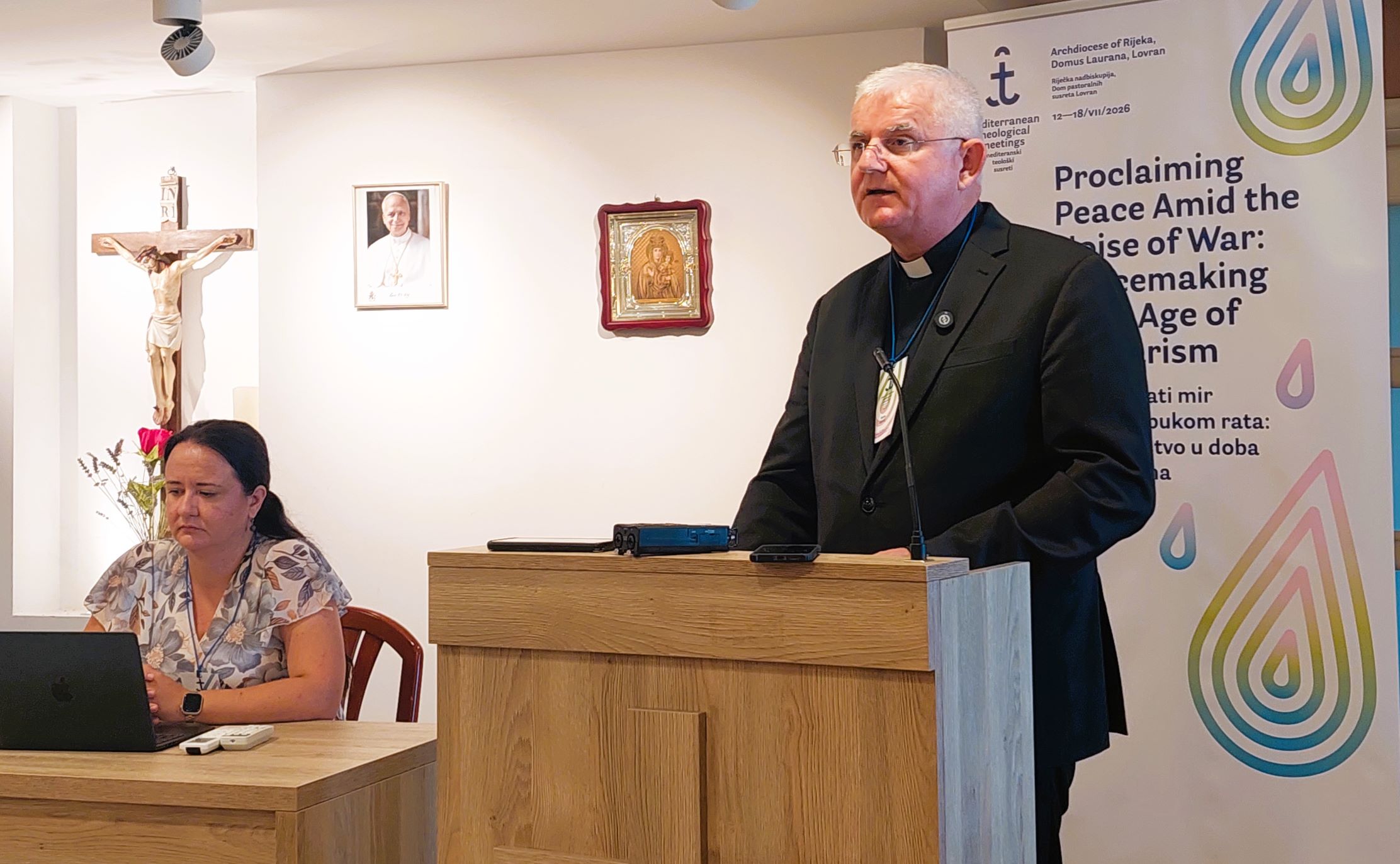
Opening Address at the Fifth Mediterranean Theological Meetings, Lovran 2026.
Dear friends,
Distinguished guests,
It is with great joy and pride, but also with a measure of unease, that I welcome you to the opening of this year’s Fifth Mediterranean Theological Meetings of theologians and theology students from the Christian Churches and from Islamic theological institutions. Together with my colleagues, I express both our satisfaction and pride that we are gathering in this setting for the seventh time. In this count, I also include the two Dubrovnik Summer Schools of Theology.
It is no small thing to experience the joy of meeting familiar faces as well as new ones, older and younger theologians, journalists, priests, friends and all of you who so generously accompany and support our work. I am convinced that over the coming week we will reflect together on peace in an atmosphere of mutual listening, respect, dialogue and thoughtful exchange, and that we will all return to our homes and communities enriched by this shared experience. As the theologian Ivan Golub once observed, the very word encounter (susret) in the Slavic languages is etymologically connected with happiness (sreća).
While thanking all those who contributed to the organization of this year’s Lovran Theological Meetings, I wish to express my particular gratitude to our speakers, both Christians and Muslims. This year they are: Sihem Djebbi, Bishop Grigorije Durić, Stipe Odak and Viola Raheb. Through their lectures they will encourage us, even during these summer days, to remain attentive to what is theologically essential: to bear more faithful witness to the God of peace and to deepen our own commitment to peacemaking.
I also warmly welcome the distinguished guests of this year’s theological encounters: Cardinal Blase Cupich of Chicago and Cardinal Ladislav Nemet of Belgrade. Through their presence and their participation, we demonstrate that the Mediterranean Theological Meetings are not merely Mediterranean in scope, but are also an expression of the catholicity – that is, the universality of the Church, which, according to the Gospel of Jesus, is called to be a place, a sign and an instrument of new and better relationships among people. Borrowing and adapting the5 words of Pope Francis from a similar theological gathering in Naples, our hope is that these encounters may become, however modestly, a theological laboratory of fraternity and friendship among peoples and nations.
Yet I also said that, alongside joy and pride, I feel a certain unease in addressing you today. This unease does not arise from a reluctance to bear witness to the faith, but rather from the demanding theme we have chosen for our reflection, and even more so from the practical commitment that ought to follow from the new insights and understanding we hope to gain. In other words, it is the very theme itself – peace – that fills me with a certain apprehension. Peace belongs to the loftiest aspirations and the deepest spirituality of human life. Indeed, who among us can truly say that they live fully in peace and are genuinely peacemakers?
The full title of this year’s Mediterranean Theological Meetings is: Prophesying Peace Amid the Noise of War: Peacemaking in an Age of Militarism. If the Catholic Church – and certainly not only the Catholic Church, but all of us – are responsible for peace in our world; if we truly wish to foster better relationships among people, to build fraternity and cultivate friendship, then we also know that, despite our best intentions, we remain, both personally and collectively, as individuals and as churches and religious communities, weak and fragile, inconsistent and sinful peacemakers.
Our title reminds us that proclaiming peace takes place within a deafening environment, amid the noise of war, and that peacemaking must be pursued in an age marked by militarism. It is as if, throughout human history, peace and peacemaking have found their natural setting precisely amid the cries of war and the spirit of constant hostility. It seems almost as though warfare and soldiering were somehow natural to humanity. That is why the word prophesying is so important: only with prophetic courage can we resist the overwhelming force of the militarism and belligerence that surround us.
Yet let us be clear from the outset. History knows no prophet of peace who did not suffer greatly for that prophecy and many paid for it with their lives. Time and again, it has been the peacemakers who were among the first victims of violence and war. Even now, somewhere in the world, voices of mockery and contempt are directed at the silenced or murdered peacemaker. “There you have him – he sought peace, dialogue, forgiveness!” – so echoes the cynical derision of the powerful and of crowds led astray.
On the other hand – and especially on the other side of war – we, together with the faithful of our respective religious traditions, profess that the God in whom we believe calls us unequivocally to peace: to the work of making peace among people. At ecumenical and interreligious gatherings, we gladly quote our sacred scriptures on peace, invoke the great peacemakers of history and reflect on the profound meaning of the words peace, shalom, and salaam. We cannot avoid speaking about one of the deepest longings of every human heart.
I, too, wish to do so. For despite all the distortions and hypocrisies that have sometimes accompanied our efforts for peace, I remain convinced that our condition of conflict will never change if we fall silent or cease to call for peace. It is in that spirit that I would like to share with you a few reflections on peace and peacemaking.
Peace with God and Unarmed Peace in Our Eyes
First, let me pose a brief question. When each of us quietly and attentively utters the word peace, do we not sense that we are not its owners? Do we not feel that peace comes from somewhere beyond us, from afar, yet also from within us—from those hidden depths of our being that we ourselves cannot fully comprehend? Let us listen once more to how the word resonates within us: PEACE. This is not mere rhetoric; it is the conviction that peace is intimately connected with the deepest mystery of our existence, with God. It is like that most important and quietest voice within us, a voice we often confuse with what is most deeply our own and yet most profoundly beyond us – the voice of God within us.
Do not all our faith traditions teach that the most important thing is to be at peace with God? And do we not identify that peace with our truest selves? For we say: to be at peace with God is to be at peace with oneself, whereas one of life’s greatest tragedies is to remain permanently unreconciled with oneself.
My first wish, therefore, for myself and for all of you is that these Mediterranean Theological Meetings – the listening and discussions, the dialogues and fellowship – may help us in our search for that inner peace which, for us believers, cannot exist without a personal and intimate communion with God. May the word peace resound from the very roots of our being.
In one of the Beatitudes from the Sermon on the Mount, Jesus says that “the peacemakers shall be called sons of God.” In the Semitic culture and language in which Jesus spoke, “sons” also includes daughters. To be a son or daughter of God – to be God’s child – and therefore brothers and sisters to one another, is the highest blessing and the deepest happiness. Blessed are those who are at peace with God, who are reconciled with their own desires and ambitions, their labours and their rest; who become such makers and mediators of peace that, in their presence, others are not afraid, need not pretend, but feel welcomed, free to be sincere, friends, children of God, equal in dignity.
The second reflection I would like to share concerns a particularly profound and demanding understanding of peacemaking. This year Pope Leo XIV has proclaimed a Year of Saint Francis of Assisi and has composed an intercessory prayer to Saint Francis for peace – an unarmed and disarming peace for our world.
For our gathering today, I would especially highlight Francis’s peacemaking encounter with Sultan al-Kamil. On the 800th anniversary of that meeting, in 2019, Pope Francis and the Grand Imam of al-Azhar, Ahmed al-Tayeb, signed the Document on Human Fraternity in Abu Dhabi. Subsequently, the United Nations proclaimed 4 February as the International Day of Human Fraternity.
In 1219, amid the tumult of the Fifth Crusade, Francis crossed the battle lines unarmed – or, as his contemporary, Jacques de Vitry, Bishop of Acre, wrote, “armed only with faith.” He entered the Muslim camp and met the Sultan. We do not know exactly how that encounter unfolded or what Francis and al-Kamil discussed. It is possible that Francis intended to convert the Sultan and his people to Christianity, even at the risk of martyrdom. What we do know is that Francis returned without the martyr’s palm and without converting the Sultan. Instead, he himself was transformed.
Dear friends, this is perhaps the most demanding form of peacemaking. It is never easy – not only in ecumenical or interreligious dialogue but in life itself – to meet one’s “enemy” face to face, armed only with faith and humanity; to speak honestly, without hypocrisy or diplomatic ambiguity; to stand before another person unarmed, with peace in one’s eyes, respecting the other’s dignity and conscious that both stand beneath God’s loving gaze.
Peace for a “Civilization of Love”
My third reflection concerns the words of Pope Leo XIV in his encyclical Magnifica Humanitas (The Greatness of Humanity). In this remarkably rich document, devoted to human action in the age of the digital revolution and artificial intelligence, the Pope gives particular attention to the evil of war, insisting that it must be named for what it is: evil.
Yet the building of a better world cannot consist merely in denouncing the evil of war, necessary though that is. It must, above all, be grounded in the decision to do good – in the construction of a civilization of love. As we know, the expression “civilization of love” was first introduced by Pope Paul VI and later developed by Saint John Paul II. Our own theologian Tomislav J. Šagi-Bunić tirelessly advocated this vision.
Consistent with his reading of the contemporary world – from his video message in September 2025 proposing that Lampedusa, one of Europe’s principal gateways for migrants, be recognized as part of humanity’s intangible cultural heritage, to this encyclical – Pope Leo XIV calls humanity to emerge from what he describes as the “globalization of powerlessness.” This appeal is addressed to everyone, not only to Catholics. No one, the Pope insists, should consider themselves too small or too powerless to contribute to building a new world shaped by love.
Reflecting on the work of peacemaking, the Pope observes:
“At this point, however, a subtle temptation may emerge, namely the thought that the problems are too big and we are too small, and that our choices, therefore, cannot make a difference. This is a polite form of resignation, often disguised as realism. Certainly, not everyone has the same power to make a difference. There are those who govern, make investment decisions, lead institutions, conduct research, educate, produce or provide information, and then there are those who only seem to live their daily lives. Yet, no one is without responsibility. We all have our own areas for action, and it is precisely there — and nowhere else — that we must choose whether to fuel the mentality of force (even if only through indifference, cynicism, lies or hatred), or to preserve the mindset of peace (with truth, moderation, closeness and care).” (MH 212)
Without pretending to exhaust the subject, Pope Leo proposes, for building a civilization of love in a time of division, conflict, war, and even cyberwarfare, “five paths toward daily and public responsibility.” Against the “culture of powerlessness”, he sets the “civilization of love.” Every person bears responsibility not only for themselves but also for others and for the world as a whole. Each of us is called to build a civilization of love rather than a civilization of conflict.
(It is noteworthy that Pope Leo deliberately avoids the widely used expression “clash of civilizations.” Presumably, he wishes the encyclical to avoid unnecessary confrontation so that its positive message may speak more clearly.)
The Pope proposes five concrete steps:
“the need to disarm words, building peace through justice, adopting the perspective of victims, cultivating a healthy realism and reviving dialogue and multilateralism” (MH 213)
1. The need to disarm words.
“The first contribution we can make toward a more humane civilization,” the Pope writes, “is to be mindful of our words. “Let us disarm words and we will help to disarm the world.” (MH 214)
I believe that we who are gathered at these theological encounters share the conviction that the time has come to become far more attentive to our speech: to guard ourselves against verbal violence, whether open or subtle; against aggression in language, prejudice, slander, and every form of demonizing rhetoric that so often characterizes today’s communication and the “cyber battlefield”. Our words, the Pope continues, should be truthful, wise, consoling, and instruments of justice in our world.
2. Peace and justice are inseparable.
The second step toward building a civilization of love is directly connected with peace. Following his predecessors, Pope Leo emphasizes that there can be no peace without justice.
“We do not merely seek any kind of peace,” he writes, – such as an absence of conflict at any cost – but instead, the true peace born of justice.” (MH 214)
Quoting Saint Augustine, the Pope encourages us never to tire of seeking justice. For we must admit that, whether from weariness or from the seductive allure of evil, we often retreat and abandon the difficult calling to be just peacemakers.
3. Seeing through the eyes of others and adopting the perspective of victims. It is difficult to know which of these five steps is most important for us, the peoples of the Mediterranean and the Balkans, of Southern and Continental Europe, wounded by historical injustices, marked by so many victims and by the feeling that others not only fail to see our suffering but even deny it. Yet this papal guideline seems particularly important for us: “Let us adopt the perspective of victims!”
Believing does not consist merely in turning inward, pursuing even the most fervent forms of asceticism and mysticism; rather, it is necessary to lift our gaze, to turn our eyes away from ourselves and to abandon self-referentiality. How desperately we lack this perspective in the “improvements” of our past, in the whitening of our personal and collective identities, in counting our own victims, in searching for pits and foibe, cemeteries and commemorations and in the mythical constructions of our victim-centered historiography.
The Pope is unequivocal and uncompromising when he writes: “There are times when, in order to remain human, we must set aside our reservations and take a stand. In some conflicts, it is unjust to remain neutral, nor is it enough merely to claim that we are not complicit. When we witness,” the Pope continues, “the bombing of civilians, attacks on hospitals, schools or vital infrastructure, and violence that affects children, we are confronted with scandals that wound humanity itself. For this reason, we cannot limit ourselves to the level of abstract analysis.” (MH 216).
The Pope calls for victims to become subjects of our thinking, speech, and practice; for us to “touch the flesh of those who suffer” (Pope Francis), to allow ourselves to be affected by the fate of the afflicted, and not to turn our heads away when human dignity is violated (MH 216). Compassion and empathy – qualities so lacking and scarce in contemporary civilization – must be restored to education, to our families, to our churches and religious communities, as indeed the God in whom we believe calls us to do. For God is infinitely compassionate, gracious and merciful. Our churches and communities should become places of living memory for victims. Pope Leo repeats the words of Paul VI that we should be “the voice of those who died in past wars and the voice of the living who still bear wounds today, so that their cries may become an appeal for peace and harmony and not a prelude to new conflicts” (MH 217).
4. Accepting reality. The peacemaker is not spared various temptations: the temptation of powerlessness; the temptation to professionalize peacemaking and become a profiteer from the conflicts and misfortunes of others; or, in zeal, the temptation of believing in the omnipotence of good intentions and embellishing harsh reality. To build a civilization of love, the Pope emphasizes, there is a need for “a healthy realism that avoids both political idealism and cynicism. There is a kind of idealism that, in order to preserve its own worldview, tends to choose facts selectively, distorting and renaming them. Its proponents eventually, inhabit a reality constructed to fit their own convictions. Conversely, there is also a debased form of realism that confuses observation with resignation, arguing that since force prevails, it will always prevail. Authentic realism does not give up on changing the world; indeed, it starts by clearly identifying interests, fears, constraints and power dynamics, precisely in order to determine what can be achieved, and the measures needed to achieve it. It does not reduce politics to morality; neither does it surrender to violence. Instead, it seeks viable paths for making peace more than a mere word, through credible institutions, verifiable guarantees, patient negotiations, conflict prevention and the protection of civilians.” (MH 218).
5. Dialogue, negotiation, and multilateralism. The final guideline for the project of our life of faith, the final important step to which Pope Leo calls us, is dialogue, together with negotiation and multilateralism. Sadly, we must acknowledge that the word dialogue causes unease among some believers and is not accepted even by certain preachers and teachers of the faith. “In order to build a civilization of love, we must,” Pope Leo insists, “engage in dialogue, for this is the primary means of coexistence between people and nations, and it is the alternative to open conflict” (MH 219). It is therefore tragic when believers – and especially theologians – stand against dialogue.
War is the greatest evil that can befall peoples and nations. Through war everything can be lost, whereas through peace and dialogue nothing is lost, the Pope repeats, echoing the teaching of his predecessors. “War is never inevitable. Weapons can and must be silenced, for they do not resolve problems […].” The Pope also explains from the depths of faith that the justification of war rests upon a certain anthropology, indeed an unbelieving view of the other, because “Our neighbors are not first our enemies, but our fellow human beings; not criminals to be hated, but other men and women with whom we can speak. Let us reject the Manichean notions so typical of that mindset of violence that divides the world into those who are good and those who are evil” (MH 222).
A Manichaean, dualistic worldview prevails among leading powers and dominant political systems. Unfortunately, it also infects believers, who then follow worldly divisions into good and evil, pure and impure, believers and unbelievers, friends and enemies. Manichaeism is a timeless ideology of the arrogant and the fearful alike, of the proud and the cowardly, of those lazy in spirit who, in their self-love, fail to see others and lack the patience and love necessary to listen, distinguish, and discern nuances.
No one is exempt from the temptation of Manichaeism. The club of moral purism and exclusion is easier to wield than the labor of thought, the search for appropriate words, compassionate vision and understanding of others. Manichaeism is a godless ideology because Manichaeans – whether theists or atheists, left or right – place themselves in the position of God, imagining themselves to be knowers of human destinies, judges of who is right and wrong, benefactors and messiahs of humankind. They herd people into enclosures, divide the world with insurmountable boundaries, and constantly hold over people the sword of self-censorship regarding where they belong and where they are welcome.
Dear friends, we have come here in order to leave behind the seductions of Manichaeism, exclusion and retreat into ethnic or religious purism. We are children of Abraham, the father of faith, who, by showing hospitality to strangers, unknowingly welcomed God himself. We are responsible for the kind of world we will leave to future generations: a hospitable world or an inhospitable one? We are obliged to build better mutual relationships, a “civilization of love.” In this Mediterranean place and time, we have been given a week to converse, to listen to one another, to learn to see through the eyes of others, to be careful in our words, and to speak the truth in love and respect for the dignity of others.
“Indeed, dialogue is an ordinary part of human life and does not only concern relations between States,” Pope Leo writes in the same encyclical on the magnificent possibility of being truly human. He adds: “It [dialogue] involves acquiring an attitude that seeks to forge bonds of fraternity built on listening, an open demeanor, making time for each other and even wasting time together. For if we experience authentic encounters with others, with those who are different, strangers and migrants, it becomes much more difficult even to imagine war.” (MH 220). Therefore, let us spend time together, converse, and “waste” time together in mutual respect and joy.
I believe that after these Mediterranean Theological Meetings we shall return to our homes and communities strengthened in our faith in God; that we shall dare to prophesy peace even while surrounded by the noise of warmongering voices; that we shall guard ourselves against every form of violence and every sacralization of hatred and war. I believe that we shall return home with greater respect and trust in human beings, including the unknown, the strangers and the despised, the victims and the afflicted, and that, with unwavering courage, we shall continue to build a “civilization of love,” founded upon just peace and universal fraternity.
May these days be fruitful for you, bringing joy, peace, and blessing.